⬅️PROCEDURES

CP3: Operational Control

This procedure describes how Breheny Civil Engineering Ltd manages operational controls, communication and consultation, document and drawing control, incident reporting and investigation, non-conformances, and customer feedback.

20
Sections
68
Key points

In this procedure

  1. 1Operational Control4 parts

    1.1–1.2 Purpose and Scope — What CP3 covers

    This sets out what CP3: Operational Control is for and who it applies to. It explains how BCE runs its Integrated Management System (IMS) day-to-day: planning, controlling, monitoring, and improving activities that affect quality, safety, environment, and energy. CP3: Operational Control applies to all employees, agency staff, contractors, suppliers, offices, depots, sites, projects and any activity the company controls or influences.

    The procedure lists the main operational areas it controls: operational planning, communication and workforce engagement, documented information, incident and emergency reporting, investigations, non-conformance handling, corrective actions, performance monitoring, and management review inputs.

    Key points

    • CP3: Operational Control turns IMS policy into everyday actions.
    • Applies company-wide — staff, contractors, sites, and projects.
    • Covers planning, communication, documentation, incidents, and improvements.
    From the source document(2 clauses)

    1.1Purpose

    This procedure defines how BCE Civil Engineering Ltd (BCE) implements, operates, controls, monitors, and improves its Integrated Management System (IMS) at an operational level. It establishes the arrangements required to ensure that the commitments, principles, and governance requirements defined within CP2 are effectively translated into daytoday operational controls across the Company ensuring the effective and compliant delivery of works, the prevention of incidents and non-conformances, and the achievement of the Company’s IMS objectives.

    It provides a consistent and structured approach to operational control, ensuring that activities which may affect quality, environmental performance, occupational health and safety, and energy performance are:

    • Planned and controlled;
    • Communicated and consulted upon;
    • Monitored and reviewed;
    • Corrected where nonconformity or deviation occurs; and
    • Continually improved.

    1.2Scope

    This procedure applies to all operational activities undertaken by BCE that fall within the scope of the IMS and applies to:

    • All employees, including agency staff;
    • Contractors, subcontractors, and suppliers working on behalf of the Company;
    • All offices, depots, sites, projects, and temporary workplaces; and
    • All activities undertaken under the Company’s control or influence.

    This procedure defines the operational control arrangements for the IMS in relation to, but not limited to:

    • Operational planning and control;
    • Communication, consultation, and workforce engagement;
    • Control of documented information and records;
    • Incident, nearmiss, and emergency reporting;
    • Incident investigation and root cause analysis;
    • Management of nonconforming outputs, complaints, and deviations;
    • Corrective action and continual improvement;
    • Operational performance monitoring; and
    • Inputs to management review.

    1.3–1.4 Operational Performance and Life-cycle Thinking

    BCE defines measurable performance criteria (KPIs) for critical processes that affect quality, safety, environment and energy. These criteria should align with IMS objectives, contracts, and be reviewed regularly.

    Operational control uses a life-cycle view — from design, procurement and construction, through use, maintenance, waste management, to project completion and demobilisation. This helps spot risks and manage impacts at every stage.

    Key points

    • Set measurable criteria for critical processes.
    • Use life-cycle view to manage risks across a project's whole life.
    • Review criteria during routine monitoring and management reviews.
    From the source document(2 clauses)

    1.3Operational Performance Criteria

    BCE shall establish, implement and maintain defined operational performance criteria for key IMS processes to ensure that products and services consistently meet specified requirements.

    Performance criteria shall be:

    • Defined for critical processes affecting quality, safety, environmental and energy outcomes;
    • Measurable, where practicable, through key performance indicators (KPIs);
    • Aligned with IMS objectives and contractual requirements; and
    • Reviewed as part of routine performance monitoring and management review.

    1.4LifeCycle Considerations

    Operational controls shall be applied using a lifecycle perspective, taking account of activities, products and services over which the Company has control or influence.

    This includes, where relevant:

    • Design and planning activities;
    • Procurement and supplier engagement;
    • Construction and site operations;
    • Use of plant, materials and energy;
    • Environmental risk and impacts;
    • Waste management and disposal; and
    • Project completion and demobilisation

    1.5 Energy Management at the Operational Level

    Energy is managed as part of CP3: Operational Control. When needed, projects get a Project Energy Management Plan (EMP) produced by the SHEQ Team using (Energy Plan – Site). Regional offices use (Energy Plan – Office). The EMP is treated like any operational control document and becomes part of the Project SHEQ Plan.

    Delivery Teams must follow the EMP, monitor energy use, and control Significant Energy Uses (SEUs). If unusual energy use appears, it must be investigated and handled like any non-conformance.

    Key points

    • EMP is an operational control and part of the Project SHEQ Plan.
    • Delivery Teams monitor SEUs and follow EMP controls.
    • Excessive or abnormal energy use triggers investigation and corrective actions.
    From the source document(1 clause)

    1.5Operational Energy Management Control

    Energy management forms part of the Company’s operational control arrangements and is implemented in accordance with the Energy Management System requirements defined in CP 2 Section 3.

    Where a Project-Specific Energy Management Plan (EMP) is required, the plan shall be treated as an operational control document and will be produced by the SHEQ Team for Projects using (Form CP2-F06). EMP’s for Regional Offices will be produced using (Form CP2-F07).

    The EMP shall be implemented on site as part of the Project SHEQ Plan and will detail responsibilities for monitoring and managing energy use, define the operational controls required to manage Significant Energy Uses (SEUs) and will remain current and effective for the duration of the Project.

    The Delivery Team is responsible for implementing the operational controls defined within the Energy Management Plan. Compliance with the plan shall be monitored through routine site inspections, audits and review of energy performance data.

    Where abnormal or excessive energy use is identified, this shall be investigated and managed in accordance with CP3 requirements for non-conforming outputs and improvement.

    Documents you'll need

    1.6 Relationship with Other IMS Documents

    CP3: Operational Control sits within the Integrated Management System (IMS) and works alongside the other Company Procedures. CP1: IMSM (IMS Manual) is the central reference register for terms, standards and legal requirements. CP2: Corporate Governance (Corporate Governance) sets the risk and management framework. CP4: Pre-Contracts (Pre-Contract) and CP5: Contract (Contract) deliver the operational work that CP3: Operational Control governs. CP6: SHEQ  (SHEQ) provides the safety, health, environmental and quality detail referenced throughout this procedure. CP3: Operational Control should always be read in conjunction with these documents and the Company's legal register.

    Key points

    From the source document(1 clause)

    1.6Relationship with Other IMS Documents

    This procedure shall be read in conjunction with CP2, which defines the overall structure, scope, governance, and strategic direction of the IMS.

    Where conflicts or inconsistencies arise:

    • CP2 shall take precedence in defining system governance and intent; and
    • CP3 shall take precedence in defining operational control requirements, unless otherwise stated.

    Supporting procedures, process maps, forms, and guidance documents referenced within CP3 form part of the IMS and are controlled in accordance with the Company’s documented information requirements.

  2. 2Communication and Consultation5 parts

    2.1 Introduction to Communication, Consultation & Participation

    This section sets out BCE's approach to effective communication, consultation and participation across the Integrated Management System. It applies to all activities tied to quality, health & safety, wellbeing, environmental and energy management.

    The aim is simple: make sure the right information reaches the right people at the right time, and that workers and interested parties are consulted and engaged where required.

    Key points

    • Covers communication, consultation and participation across the whole IMS.
    • Applies to quality, H&S, wellbeing, environmental and energy topics.
    • Workers and interested parties must be informed and engaged.
    From the source document(1 clause)

    2.1Introduction

    This section defines BCE’s approach to ensuring effective communication, consultation and participation in relation to the IMS. It applies to all activities associated with quality, health and safety, wellbeing, environmental and energy management and is designed to ensure that relevant information is communicated appropriately, and that workers and interested parties are consulted and engaged where required.

    2.2 Responsibilities for Communication & Consultation

    Directors are responsible for ensuring communication and consultation processes are established, implemented and maintained.

    Department and Delivery Managers implement these arrangements in their areas of control and promote effective two-way communication with the workforce.

    All employees are encouraged to actively participate, and to raise concerns, suggestions or opportunities for improvement.

    Key points

    • Directors own the communication & consultation framework.
    • Managers run it day-to-day and drive two-way communication.
    • Every employee can raise concerns, ideas and improvements.
    From the source document(1 clause)

    2.2Responsibilities

    The Directors shall be responsible for ensuring that appropriate communication and consultation processes are established, implemented and maintained.

    Department and Delivery Managers shall be responsible for implementing communication and consultation arrangements within their areas of control and for promoting effective twoway communication with the workforce.

    All Employees are encouraged to actively participate in communication and consultation processes and to raise concerns, suggestions or opportunities for improvement.

    2.3 Communication — What, When, and How

    CP3: Operational Control explains what IMS-related information must be communicated, when, to whom, and by what means. Communications must be clear, timely and relevant. Internal methods include meetings, toolbox talks, training, digital platforms and daily interactions. Topics include policies, roles, incidents, changes, emergency arrangements and energy performance.

    External communication covers clients, regulators, certification bodies, emergency services, suppliers and other stakeholders. The company decides what IMS information to share externally and ensures it matches internal records.

    Key points

    • Communicate IMS info clearly and on time to the right people.
    • Use a mix of oral, written, and digital communication methods.
    • External communications are controlled and consistent with IMS records.
    From the source document(4 clauses)

    2.3Communication

    No text in source for this clause.

    2.3.1General

    The company shall determine and implement internal and external communications relevant to the IMS, including:

    • What is communicated
    • When communication takes place
    • With whom communication is undertaken
    • How communication is carried out

    Communication shall be appropriate, timely, clear, and relevant to the intended audience.

    2.3.2Internal Communication

    Internal communication is used to ensure that Employees and those working on BCE projects are informed and engaged in matters relating to the IMS, including where relevant:

    • IMS policies, objectives and performance
    • Roles, responsibilities and accountabilities
    • Changes to processes, procedures, equipment or working methods
    • Health, safety, wellbeing, environmental and energy matters
    • Incidents, near misses, corrective actions and lessons learned
    • Emergency arrangements and preparedness
    • Legal or other significant updates affecting operations

    Communication relating to energy management is designed not only to raise awareness, but to support continual improvement of energy performance, including understanding of the Energy Policy, objectives, Significant Energy Uses (SEUs), Energy Performance Indicators (EnPIs), and the role of individuals in achieving energy performance improvements.

    Internal communication may include meetings, briefings, toolbox talks, training activities, written communications, digital platforms, day to day interactions and other appropriate methods.

    2.3.3External Communication

    External communication is undertaken as appropriate to meet legal, contractual and stakeholder requirements.

    This may include communication with, but is not limited to:

    • Clients and customers;
    • Regulatory and enforcing authorities;
    • Certification bodies;
    • Emergency services;
    • Suppliers, subcontractors and service providers;
    • Other relevant interested parties.

    BCE shall determine what IMS related information is communicated externally and ensure that such communication is consistent with information generated within the management system.

    2.4–2.5 Consultation, Participation and Wellbeing

    Staff must be consulted on matters that affect safety, environment, energy and wellbeing. BCE promotes two-way engagement so workers can raise hazards, incidents, or improvements without fear of reprisal. Methods include safety committees, toolbox talks, reporting systems, and one-to-one chats.

    2.5 Employee Assistance and Wellbeing Communication

    Employee wellbeing services (like the Employee Assistance Programme) are communicated during induction and ongoing engagement. Barriers to participation are identified and removed where practicable.

    Key points

    • Encourage two-way communication and safe reporting.
    • Consult employees on risks, changes and improvement ideas.
    • Promote wellbeing services and make participation easy.
    From the source document(5 clauses)

    2.4Consultation and Participation

    No text in source for this clause.

    2.4.1General

    BCE shall ensure effective consultation and participation of Employees on matters affecting health, safety, wellbeing, environmental and energy performance to seek their views in line with the Company’s continuous improvement objectives.

    BCE ensures that Employees and those working on BCE projects have timely access to clear, relevant and understandable information relating to the IMS, and are able to raise hazards, concerns, incidents and improvement suggestions without fear of reprisal or disadvantage. Barriers to effective participation, including organisational, cultural or communication are actively identified and removed where reasonably practicable.

    2.4.2Matters Subject to Consultation and Participation

    Employees shall be consulted and encouraged to participate, as appropriate, in relation to:

    • Hazard identification, risk assessment and control measures
    • Incident and nearmiss reporting and investigation
    • Changes that may affect health, safety, wellbeing, environmental or energy performance
    • The introduction of new processes, equipment or technologies
    • Development and review of IMS arrangements
    • Identification of improvement opportunities

    2.4.3Methods of Consultation and Participation

    Consultation and participation may be achieved through a range of formal and informal mechanisms, including:

    • Toolbox talks and safety briefings
    • Workforce engagement activities and site interactions
    • Health and safety committees or forums
    • Reporting systems for hazards, incidents and improvement ideas
    • Open communication with Department or Delivery Managers and Directors

    2.5Employee Assistance and Wellbeing Communication

    BCE Employee wellbeing support services, including the Employee Assistance Programme (EAP), shall be communicated to Employees and promoted as part of induction and ongoing engagement activities.

    2.6–2.7 Records, Evidence, Review and Improvement

    All communication and consultation activity must be recorded as evidence that engagement has taken place. Records include meeting minutes, toolbox talk registers, briefing sheets, consultation responses and wellbeing communications. Records are retained in line with the Company's document retention rules and made available for audits, reviews and investigations. The effectiveness of communication and consultation is reviewed regularly (typically through Management Review and SHEQ committees) so that methods, frequency and content can be improved where gaps are identified.

    Key points

    • Keep evidence of every briefing, toolbox talk and consultation
    • Use the records to demonstrate compliance during audits
    • Review effectiveness through Management Review and SHEQ committees
    • Update methods, content and frequency when gaps are found
    • Retain records in line with the Company's document retention rules
    From the source document(2 clauses)

    2.6Records and Evidence

    Where required, outputs from communication and consultation activities (such as actions, decisions, feedback or issues raised) shall be retained as documented information in accordance with the Document and Drawing Control procedure.

    2.7Review and Improvement

    The effectiveness of communication and consultation arrangements shall be reviewed as part of ongoing performance monitoring, internal audits and management review, and improved where necessary.

  3. 3Document and Drawing Control4 parts

    3.1–3.3 General, Maintained & Retained Documented Information

    BCE establishes, implements and maintains controls so all IMS documented information is available where needed, suitably protected (from loss of confidentiality, misuse or loss of integrity), and properly identified, distributed, accessed, stored, retrieved, retained and disposed of.

    CP3: Operational Control distinguishes two types of company documents:

    • Maintained documented information — current policies, procedures, drawings, work instructions and templates that must be kept up to date and available for use.
    • Retained documented information — records and evidence (completed forms, inspections, training records, incident reports, archived project files) kept for traceability and legal or contractual reasons.

    Both types must be legible, protected, retrievable and kept for defined periods. Superseded versions are archived and removed from active use.

    Key points

    • Keep current documents up to date and accessible at the point of use.
    • Retain records as evidence and for legal/contractual periods.
    • Archive superseded documents and protect stored information.
    From the source document(3 clauses)

    3.1General

    BCE shall establish, implement, and maintain controls to ensure that documented information required by the IMS is:

    • Available and suitable for use;
    • Adequately protected from loss of confidentiality, improper use, or loss of integrity; and;
    • Controlled throughout its lifecycle.

    Documented information includes the IMS, policies, drawings, records, forms, registers, reports, and any other information required to support the effective operation of the IMS.

    3.2Maintained Documented Information

    Maintained documented information is information that shall be kept up to date to support the planning, operation and control of the IMS.

    This includes, but is not limited to:

    • Policies and procedures
    • Drawings, technical diagrams and design documents
    • Work instructions and guidance documents
    • Approved company templates and forms
    • Live drawing and document registers

    Maintained documented information shall be reviewed and approved prior to issue, controlled through revision status, made available at the point of use in its current approved version, and superseded versions shall be withdrawn from operational use and archived.

    3.3Retained Documented Information

    Retained documented information is information that shall be kept as evidence of activities performed, results achieved or compliance with legal, contractual or IMS requirements.

    This includes, but is not limited to:

    • Completed forms and records
    • Registers, logs and reports
    • Inspection, audit and monitoring records
    • Training, competence and briefing records
    • Accident, incident and investigation records
    • Archived project documentation and communications
    • Superseded drawings and documents retained for traceability

    Retained documented information shall be legible, identifiable and retrievable, protected from loss or unauthorised alteration, retained for defined periods and securely disposed of when no longer required.

    3.4–3.11 Responsibilities and Document Control Rules

    SHEQ Team owns control of IMS documents. Document Owners keep content accurate and suitable. Document Control administers the Electronic Document Management System (EDMS) for registration, distribution and archiving. All staff must use only the current approved versions.

    Documents must display title, reference, revision, issue date and owner. Changes require approval before issue; downloaded copies are 'Uncontrolled' and must be marked as such. Reviews are scheduled and updates communicated to affected employees.

    Key points

    • SHEQ Team, Document Owners and Document Control share document duties.
    • Always use controlled EDMS versions; mark downloads 'Uncontrolled'.
    • Changes need review and approval before release.
    From the source document(8 clauses)

    3.4Responsibilities

    • The SHEQ Team shall be responsible for the control, maintenance and updating of IMS documented information.
    • Document Owners shall be responsible for ensuring documents remain accurate, suitable and reviewed as required.
    • Document Control shall be responsible for EDMS administration, document registration, distribution and archiving.
    • All Employees shall ensure that only current approved documented information is used.

    3.5Control of Documented Information

    Controlled copies of Company Procedures are maintained on the Company EDMS, which serves as the Common Data Environment (CDE) for sharing information across the project team.

    3.6Identification and Format

    All IMS documented information shall be clearly identifiable by:

    • Title
    • Reference number
    • Revision status
    • Issue date
    • Document owner

    Approved Company templates shall be used where applicable. Documents and forms associated with these Procedures shall be referenced accordingly.

    Client, Principal Contractor, or subcontractor forms may be used where they provide an equivalent level of quality and information. Copies of such forms shall be retained and uploaded to the relevant EDMS project workspace.

    3.7Revision, Change, Review and Approval

    All changes to documented information shall be controlled. Superseded documents shall be removed from use and archived.

    Requests for amendments shall be submitted to the Head of ESG. No changes to forms or reference numbers are permitted without approval, unless otherwise stated in these procedures.

    IMS documents shall not be issued or used unless formally reviewed and approved.

    Documents shall be reviewed at appropriate intervals to ensure continued suitability, adequacy, and effectiveness, particularly following significant changes, incidents, audits, or legislative updates, or as required by the Document Owner or SHEQ Team.

    Amendments and updates shall be communicated to all affected Employees.

    3.8Access, Distribution and Availability

    Controlled documents shall be accessible via the Company EDMS. Downloaded documents are considered uncontrolled and must be marked “Uncontrolled Copy.”

    Documents shall be distributed in accordance with defined distribution requirements, with updates communicated via EDMS notifications or Email.

    Health, Safety, Quality, Environmental, and CDM documents shall be completed electronically or in ink if handwritten. All forms shall be completed as fully and made readily accessible to all Employees.

    3.9External Documented Information

    Externally produced documents, including legislation, British Standards, Codes of Practice and Client documentation, shall be identified and controlled where necessary for the operation of the IMS.

    Current legislation and standards shall be managed through SHEQ information service providers and/or verified current editions. Documents held locally or on the EDMS shall not be assumed to be current without verification.

    3.10Retention and Disposal

    Project documentation shall be archived at the conclusion of the defects/maintenance period, once all contractual obligations have been met and all as‑built, commercial and close‑out records are complete.

    All project documentation and electronic communications shall be archived within the EDMS for at least 15 years

    Health and Safety, Quality, Environmental and CDM Documents will be maintained by the SHEQ Team for a minimum of 6 years. However, Accident and Incident Reports will be maintained indefinitely.

    All accident book entries shall be retained for a period of 5 years.

    Occupational Health Surveillance records shall be held for 40 years.

    Drawings must be retained for the duration of the project and for a period as specified by statutory requirements and Client agreements. All retained drawings must be securely stored and available for audit or review as required.

    Unsuccessful Tender Documents shall be retained for a period of 2 years.

    Records and Documents due for disposal are reviewed by the Head of Department for any open issues. If there are no valid reasons for continued retention of the document, they shall be sent for disposal by an appropriate method.

    3.11Data Protection

    Personal data contained within documented information shall be processed, stored, transferred and disposed of in accordance with UK GDPR and the Data Protection Act 2018.

    3.12–3.15 Drawing Control — Creation, Review and Release

    All technical drawings (design, construction, as-built) are stored on the EDMS project workspace using unique references. Drawings are created by qualified staff or received from clients/designers and must use approved standards and software.

    The Delivery Team reviews incoming drawings and raises queries for discrepancies. Each issued drawing must have a unique ID and revision. A drawing is only approved for construction or submission when formally released by the authorised person and marked with its release status.

    Key points

    • Store drawings on EDMS with unique IDs and revision control.
    • Review incoming drawings and raise technical queries for issues.
    • Only formally released drawings are valid for construction.
    From the source document(4 clauses)

    3.12Drawing Control

    This applies to all engineering drawings, technical diagrams, and design documents issued or produced and used by BCE, including but not limited to design drawings, construction drawings, site plans, and as-built drawings.

    All drawings received are to be stored in the uniquely referenced project workspace on the EDMS to allow information to be shared between all members of the Delivery Team.

    3.13Drawing Creation

    Drawings are created and issued by the Client or Designers or produced in-house, typically as as-built drawings. Drawings are created by qualified technical personnel based on project requirements, client specifications, and relevant regulations.

    The appropriate software (AutoCAD, Revit, etc.) and standards (e.g., BS 1192, ISO 129-1) should be used to ensure consistency and accuracy.

    3.14Drawing Review and Approval

    The Delivery Team will review the drawings on receipt and any discrepancies found will be queried with the Client through technical queries or by other defined contractual arrangements.

    Revised drawings shall undergo the same level of review and approval as the original issue with each new drawing being assigned a unique identification and revision number to ensure full traceability. Upon revision, a new version shall be issued and the previous version archived, with all superseded drawings relocated to the superseded folder and removed from active use.

    3.15Drawing Approval & Release

    Drawings are only considered valid and issued for construction or client submission once they are formally approved and released by the appropriate authority, unless a contractual instruction is received from the Client or the Clients representative instructing there use.

    The release status of a drawing must be indicated on the drawing itself (e.g., "Approved for Construction", "Issued for Tender", etc.).

    3.16–3.18 Pre-contract, Contract Drawings & Distribution

    Pre-contract drawings are emailed to precontractdrawings@breheny.co.uk and saved to a defined EDMS folder. The Document Controller extracts, retitles, uploads and notifies recipients.

    Contract drawings must be stamped 'For Construction' before work starts (unless the Client instructs otherwise). Delivery Managers send new or revised contract drawings to contractdrawings@breheny.co.uk for EDMS upload. A controlled copy is stored in a locked admin area accessible only to the Document Controller and Directors.

    3.18 Drawing Distribution

    The Document Controller maintains a drawing distribution list for each project and logs every distribution to track which individuals or teams received which drawing and revision. This register provides an audit trail of who holds the current version.

    Useful email addresses

    • precontractdrawings@breheny.co.uk — pre-contract / tender drawings and associated documents
    • contractdrawings@breheny.co.uk — contract drawings issued 'For Construction' and revisions

    Key points

    • Use the dedicated email inboxes for pre-contract and contract drawings.
    • Document Controller manages naming, uploading and distribution.
    • Maintain a drawing distribution list and log every issue to track version recipients.
    From the source document(3 clauses)

    3.16Pre - Contract Drawing and associated documents

    On receipt of a tender and during the tender period all documentation and drawings are to be sent to precontractdrawings@breheny.co.uk for booking in. A date of receipt shall be included in the body of the email to ensure the drawing register is accurate.

    The documents and drawings as received from the Client shall be saved on the EDMS by the Document Controller in the following location

    • K:\Project Filing\0**** - Project Title\Pre-Contract\A Tender Docs\Received ZIPS

    Documents and drawings shall be extracted, opened and retitled if incorrect to reflect the drawing no. / title / revision on the PDF. Any discrepancies shall be notified to the Estimator by the Document Controller.

    Retitled drawings and documents will be uploaded to the EDMS by the Document Controller in the following locations, previous revisions are to be superseded and moved to the superseded folder.

    • K:\Project Filing\0**** - Project Title\Pre-Contract\B Drawings
    • K:\Project Filing\0**** - Project Title\Pre-Contract\A Tender Docs

    Drawing and document registers will be uploaded to the EDMS in the following locations

    • K:\Project Filing\0**** - Project Title\Pre-Contract\B Drawings\Drg Register
    • K:\Project Filing\0**** - Project Title\Pre-Contract\A Tender Docs

    The Document Controller shall distribute the updated drawings, documents and registers to all recipients on the project distribution list.

    3.17Contract Drawings and associated documents

    The Delivery Managers shall obtain a full set of drawings stamped “For Construction” before commencing work on site, unless a contractual instruction is received from the Client or the Clients representative instructing the use of the tender issued information. The Commercial Director shall ensure that the Contract references the latest received drawings and documents of which the tender was based upon.

    The Delivery Managers shall send all drawings and documents as received to contractdrawings@breheny.co.uk to be added to the EDMS. This includes any subsequent drawings and documents or revisions throughout the project. A date of receipt shall be included in the body of the email to ensure the drawing register is accurate.

    The Delivery Team can develop their own uniform filing structure at the following location however this will be uncontrolled and must be in addition to the below clauses, not in lieu of.

    • K:\Project Filing\0**** - Project Title\Contract\7 Drawings

    The Document Controller shall upload all new drawings to the EDMS, supersede the old drawings and distribute the updated drawings, documents and registers to all recipients on the project distribution list.

    A controlled version of all drawings and documents will be filed at the following locations and will be locked and only accessible by the Document Controller and Directors

    • K:\Project Filing\0**** - Project Title\Contract\7 Drawings\Admin
    • K:\Project Filing\0****-Project Title\Contract\1 Admin\Specs & supp. Docs\Admin

    3.18Drawing Distribution

    A drawing distribution list shall be maintained by the Document Controller for each project

    Any distribution of drawings shall be logged by the Document Controller to track which individuals or teams have received which version of each drawing.

  4. 4Incident Reporting3 parts

    4.1–4.2 Incident Reporting — What to report and how

    All hazards, near misses, incidents, dangerous occurrences, service strikes, occupational illnesses and environmental incidents must be reported regardless of severity. Report early to comply with legal rules (like RIDDOR) and to identify prevention opportunities.

    The Delivery Team must phone the SHEQ Advisor and Contracts Manager immediately and submit an Incident Record Part A (Form ) within 24 hours to sheqadmin@breheny.co.uk. The SHEQ Team decides if a formal investigation is needed and assigns investigators.

    Related process charts: (Incident Reporting Process Map), (Personal Injury Claims Process Map), (Third Party Claims Process Map).

    Key points

    • Report every incident or near miss — no matter how small.
    • Phone SHEQ Advisor/Contracts Manager, then file Form within 24 hours.
    • SHEQ decides investigation level and assigns investigators.
    From the source document(2 clauses)

    4.1Introduction

    This procedure defines how Breheny Civil Engineering reports, records and manages all accidents, incidents, dangerous occurrences, occupational diseases and significant environmental events. It ensures compliance with RIDDOR, establishes clear responsibilities for prompt notification and investigation, and sets out the processes for handling personal injury and thirdparty claims. CP3 Section 4.0 Incident Management supports consistent incident management across the business and promotes proactive reporting to drive continual improvement

    4.2Incident Reporting

    All hazards, incidents, dangerous occurrences, service strikes, occupational illhealth, near misses, environmental incidents, and safety concerns shall be reported, regardless of severity or outcome. This requirement applies to all Employees, Contractors, and others working on behalf of the Company

    Reporting supports compliance with applicable legal and regulatory requirements, including the Reporting of Injuries, Diseases and Dangerous Occurrences Regulations (RIDDOR), and enables the identification of hazards, emerging risks, and opportunities for prevention and continual improvement.

    The Delivery Team are to telephone the SHEQ Advisor and Contracts Manager notifying them of the Incident. They shall follow this up by completing and emailing an Incident Record Part A (Form CP3-F03) to sheqadmin@breheny.co.uk and Contracts Manager within 24 hours.

    Additional details of reporting timescales are shown on Reporting and investigation Lines on Chart CP3-4.3

    Process Chart CP3-4.1.1 defines the process for reporting accidents, environmental incidents, dangerous occurrences and industrial diseases and timescales for reporting.

    Process Chart CP3-4.1.2 defines the process for dealing with Personal Injury Claims.

    Process Chart CP3-4.1.3 defines the process for dealing with Third Party claims.

    In all incidents the Head of ESG, if considered appropriate, shall arrange for an investigation into the incident to be carried out by a competent person. The Investigator shall complete an Incident Investigation Report either formal or informal dependent on severity using the following forms:

    Documents you'll need

    4.3–4.4 Managing Emergencies and Injury Recovery

    Each project must have clear emergency arrangements: stop work if needed, make the area safe, evacuate, and call emergency services. Report emergencies promptly to SHEQ, Contracts Manager and Directors if severe. Where possible, a Delivery Team member should accompany an injured person to hospital and support must be offered (including counselling).

    Return-to-Work interviews are required after injury-related absences to ensure fitness, review the incident, and identify training or changes to prevent recurrence. Post-incident drug and alcohol testing is mandatory for high-potential incidents — contact HR immediately to arrange tests.

    Related process chart: (Incident Investigation — Notification Timescale).

    Key points

    • Follow emergency plans: make safe, evacuate, contact emergency services.
    • Support injured people and carry out Return-to-Work interviews.
    • Arrange drug/alcohol testing for high-potential incidents via HR.
    From the source document(2 clauses)

    4.3Management of Incidents and Emergency Situations

    Each Regional Office / Project shall implement arrangements to ensure emergencies are managed effectively, including following the appropriate plan, stopping work, making the area safe, evacuating personnel, and contacting emergency services where required. Relevant emergency plans (e.g., Site or Environmental Emergency Plans) must be implemented in line with Process Chart CP3-5.3C.

    Incidents and emergencies must be reported as soon as possible to the SHEQ Team, Contracts Manager, and depending on severity a Director.

    Where practicable, a Delivery Team member must accompany any injured person requiring hospital treatment and remain with them until treatment is complete. Consideration should also be given to contacting HR to arrange counselling support for anyone affected by or witnessing a serious incident.

    Emergency preparedness, including planning, fire risk assessments, drills, and testing of arrangements, shall be managed in accordance with CP6 Section 6 and associated standards and guidance.`

    4.4Injury Management

    Appropriate arrangements shall be made to monitor absence resulting from injuries and in assisting the employee to return to work at the earliest opportunity.

    Immediately following an incident that has the potential to become a Lost Time Injury or Modified Work Duties, the Delivery Team must contact the injured person at home/hospital to establish their condition and offer any assistance to aid their recovery.

    A Return-to-Work interview must be conducted where any employee has been absent from work as a result of an incident. The interview must be conducted by the Delivery Team with support from Human Resources and the Head of ESG, prior to returning to work. The purpose of the interview is to:

    • Ensure the injured person is fit to return to normal duties;
    • Be clear on the circumstances surrounding the incident;
    • Identify any refresher or additional training that may be required;
    • Identify any changes to working methods that may prevent a recurrence.

    4.5 Post-Incident Drugs and Alcohol Testing

    Following a notifiable incident, the Company may require those involved to undergo drugs and alcohol testing in line with the Company's Drugs & Alcohol Policy. Testing is arranged through approved providers and is treated confidentially. Refusal to participate, or a positive result, is dealt with under the Company's disciplinary procedure. The purpose of testing is to safeguard workers, protect the public and meet client and regulatory expectations on safety-critical sites.

    Key points

    • Testing may be required after any notifiable incident
    • Arranged through approved providers and handled confidentially
    • Aligned with the Company's Drugs & Alcohol Policy
    • Refusal or positive results are managed under disciplinary procedure
    • Protects workers, the public and meets client/regulatory expectations
    From the source document(1 clause)

    4.5Post Incident Drugs & Alcohol Testing

    Testing of all involved in an incident is mandatory in the event of any high potential incidents or high potential near misses or reportable dangerous occurrence, for example incidents or near misses involving mobile plant or services strikes, involving gas or electricity.

    Contact HR as soon as practicable after the incident (or, if unavailable, the Regional SHEQ Advisor) to arrange testing; those involved must remain on site.

  5. 5Incident Investigation2 parts

    5.1–5.4 Investigations — Classification, Process and Root Cause

    Incidents are classified to determine the investigation level: informal (minor injuries, low-risk incidents) or formal (fatalities, LTIs, dangerous occurrences, high-potential events). The Head of ESG decides if there’s ambiguity.

    Investigations must be proportionate, led by competent people, and preserve evidence. Informal and formal processes use specific process maps and forms. Draft reports are due within 10 working days and final reports within 20 days. Root cause is found using the ‘5 Whys’ and categories such as design, equipment, procedures, competence, communication and management control are considered.

    Forms: (Incident Report — Part A), (Incident Statement), (Informal Investigation Report) and (Incident Investigation Report — Part B). Related process charts: (Safety Incident Classification), (Environmental Incident Classification), (Crisis Management Process Map), (Informal Incident Investigation Process) and (Formal Investigation Process Map).

    Key points

    • Classify incidents to choose the right investigation level.
    • Draft report within 10 days; final report within 20 days.
    • Use '5 Whys' and root cause categories to identify corrective actions.
    From the source document(4 clauses)

    5.1Introduction

    Investigations of incidents, near misses, dangerous occurrences, occupational illhealth, and environmental incidents are undertaken post incident.

    They are undertaken to:

    • Establish what happened and why;
    • Identify root causes and contributing factors;
    • Determine whether existing controls were effective; and
    • Identify corrective and preventive actions to improve performance.

    Investigations shall be carried out in a proportionate and riskbased manner, reflecting the actual or potential severity of the event. The findings of investigations shall be used to support learning, corrective action, and continual improvement of the IMS.

    5.2General

    Management shall ensure that sufficient resources and competent/trained personnel are made available to manage and fully investigate any incidents. Including adequate instruction to all employees and contractors to ensure all incidents are thoroughly managed, reported and investigated.

    Employees and contractors shall cooperate fully with any incident investigation, ensuring that any evidence vital to these investigations remains undisturbed as far as reasonably practicable.

    5.3Classification of IncidentsEdited

    To support effective communication and investigation, the person completing the Part A Incident Record must classify the incident type in accordance with the Classification of Safety Incidents (CP3.5.A) and Classification of Environmental Incidents (CP3.5.B). The SHEQ Team will verify the classification on receipt and update it if required.

    Where a major incident occurs e.g. Fatality, multiple Lost Time Injuries (LTI), serious environmental permit breach etc., the Crisis Management Plan CP3.5.C must be consulted.

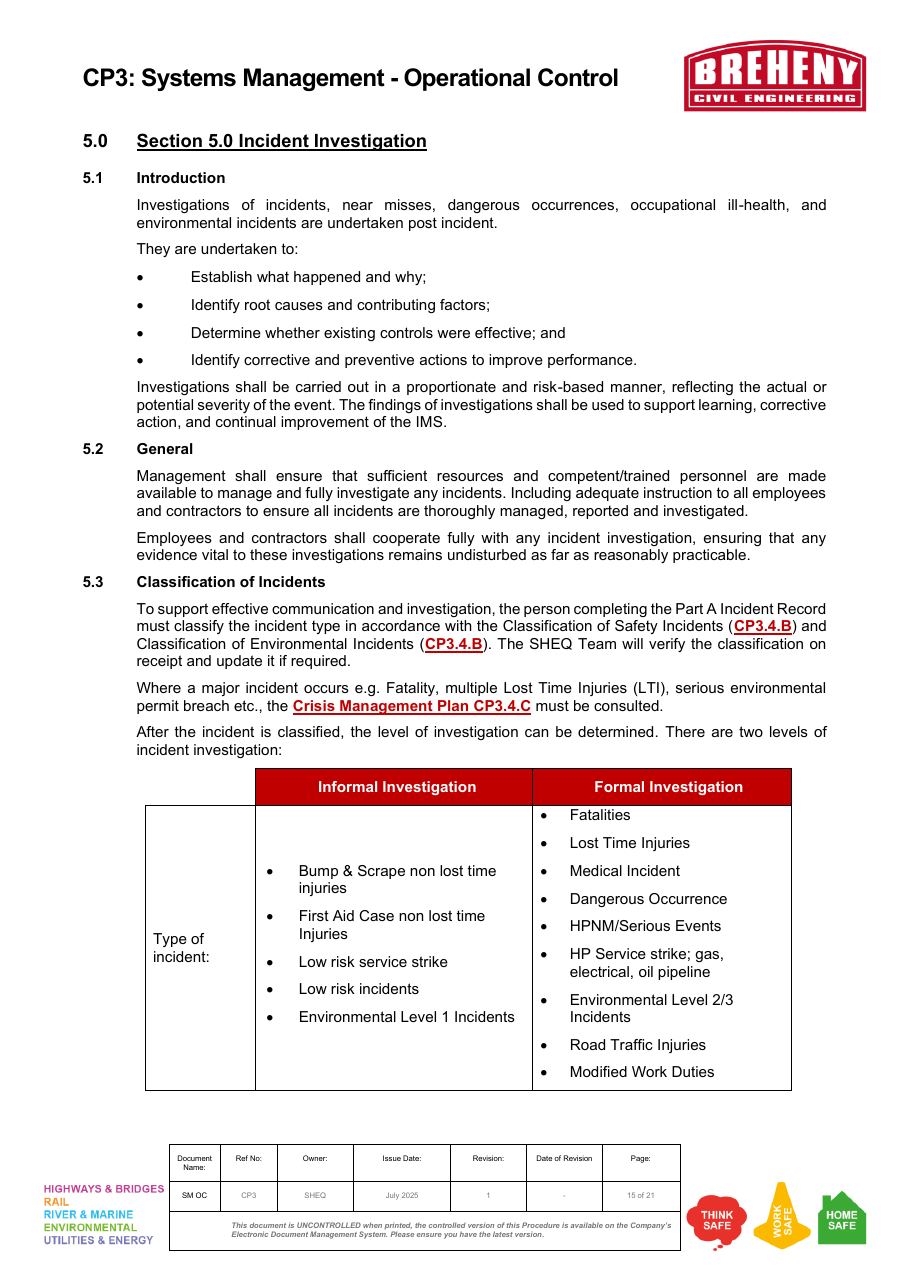
    After the incident is classified, the level of investigation can be determined. There are two levels of incident investigation:

    (see table below)

    Definitions for the terms in the table above are provided in CP1 IMS Manual, Section 3.0 (Terms & Definitions).

    In the event of any ambiguity on the level of investigation required the Head of ESG will determine the level of investigation required.

    5.4Investigation of IncidentsEdited

    Investigation teams will be established by the SHEQ Team and supported by Head of ESG. They shall liaise with all involved in the incident to determine the cause of the incident. The task and activities of a similar nature must cease on site until an initial decision is made by the investigation lead as to whether it’s safe to continue.

    The SHEQ Team will produce an incident report following their investigation using the relevant form, it will include, witness statements using form CP3-F04 and all necessary supporting evidence.

    For an informal investigation process map CP3.5A must be followed and the investigation recorded using form CP3-F05.

    For a formal investigation process map CP3.5B must be followed and the investigation recorded using form CP3-F06.

    A draft investigation report must be completed within 10 working days of the incident occurring and the final report completed within 20 working days of the incident occurring. Where required an interim investigation report shall be produced to satisfy Client’s needs.

    The findings of the report will be notified to the relevant Department Manager or Contracts Manager for comment and to ensure actions are adequately closed out.

    The root cause of the incident will be established using the “5 Why” process, which is part of BCE’s Root Cause Analysis procedure.

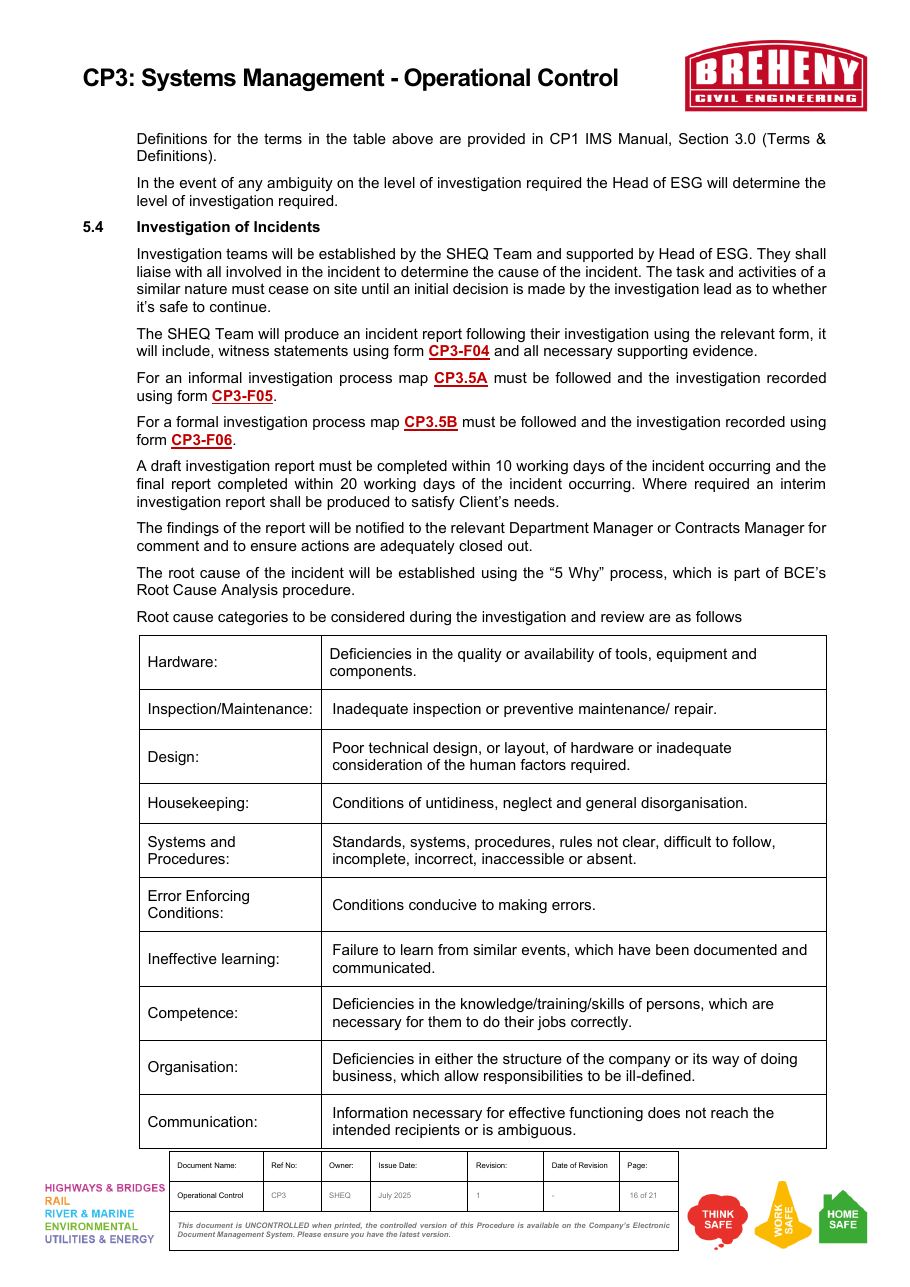
    Root cause categories to be considered during the investigation and review are as follows

    (see table below)

    Documents you'll need

    5.5–5.6 External Reporting, Reviews and Fair Culture

    If an incident needs reporting to regulators (RIDDOR), the Head of ESG or nominee will submit it within legal timescales. Examples include deaths, specified injuries, over-seven-day incapacitation, and hospital-treated non-workers.

    Serious investigations trigger post-incident review meetings led by SHEQ with Contracts and Delivery Managers. If individual behaviour is a factor, follow the Fair Culture procedure to decide whether actions were blameworthy or blameless and apply appropriate measures (training, coaching or disciplinary). Reviews confirm root causes and ensure corrective actions are effective.

    Key points

    • Head of ESG handles regulatory reporting within required timeframes.
    • Serious incidents require a post-incident review with senior staff.
    • Apply Fair Culture principles when individual actions contributed to incidents.
    From the source document(2 clauses)

    5.5External ReportingEdited

    Any incident requiring notification to an external enforcing authority will be notified by the Head of ESG or nominated representative, within the appropriate time scale.

    A report must be received within 10 days of the incident.

    For accidents resulting in the over-seven-day incapacitation of a worker, the enforcing authority must be notified the within 15 days of the incident, using the appropriate online form. Cases of occupational disease, including those associated with exposure to carcinogens, mutagens or biological agents, as soon as the responsible person receives a diagnosis, using the appropriate online form.

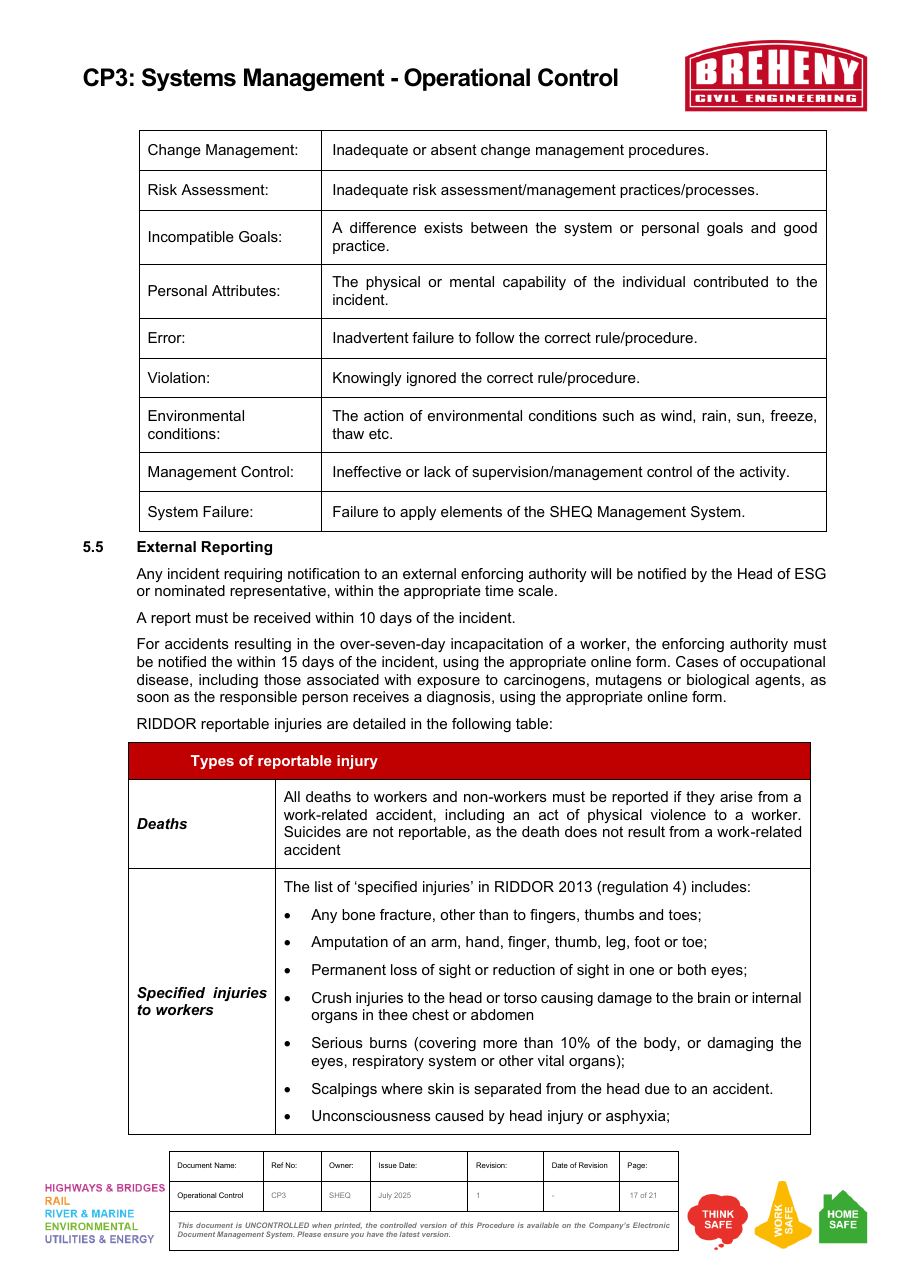
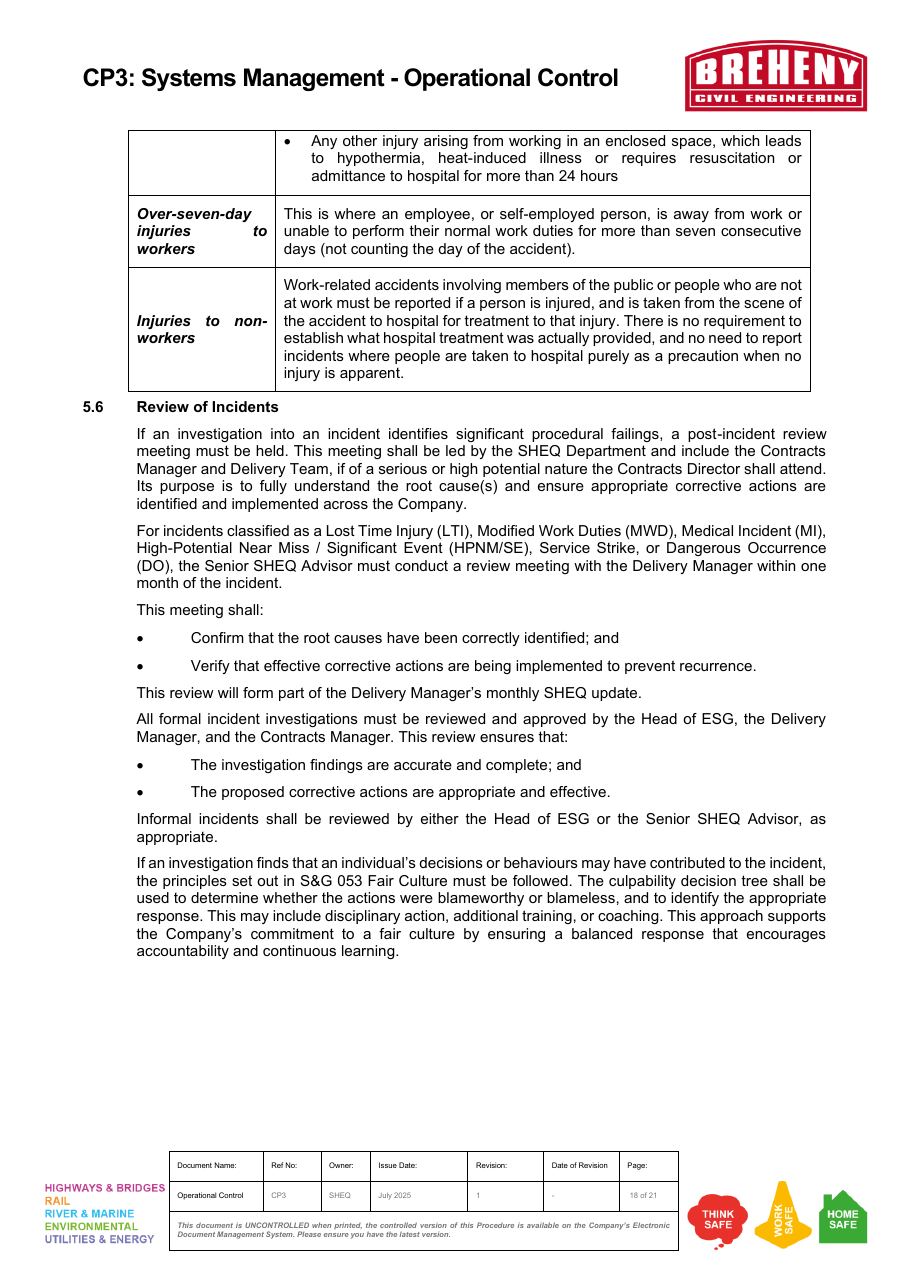
    RIDDOR reportable injuries are detailed in the following table:

    (see table below)

    5.6Review of Incidents

    If an investigation into an incident identifies significant procedural failings, a post-incident review meeting must be held. This meeting shall be led by the SHEQ Department and include the Contracts Manager and Delivery Team, if of a serious or high potential nature the Contracts Director shall attend. Its purpose is to fully understand the root cause(s) and ensure appropriate corrective actions are identified and implemented across the Company.

    For incidents classified as a Lost Time Injury (LTI), Modified Work Duties (MWD), Medical Incident (MI), High-Potential Near Miss / Significant Event (HPNM/SE), Service Strike, or Dangerous Occurrence (DO), the Senior SHEQ Advisor must conduct a review meeting with the Delivery Manager within one month of the incident.

    This meeting shall:

    • Confirm that the root causes have been correctly identified; and
    • Verify that effective corrective actions are being implemented to prevent recurrence.

    This review will form part of the Delivery Manager’s monthly SHEQ update.

    All formal incident investigations must be reviewed and approved by the Head of ESG, the Delivery Manager, and the Contracts Manager. This review ensures that:

    • The investigation findings are accurate and complete; and
    • The proposed corrective actions are appropriate and effective.

    Informal incidents shall be reviewed by either the Head of ESG or the Senior SHEQ Advisor, as appropriate.

    If an investigation finds that an individual’s decisions or behaviours may have contributed to the incident, the principles set out in S&G 053 Fair Culture must be followed. The culpability decision tree shall be used to determine whether the actions were blameworthy or blameless, and to identify the appropriate response. This may include disciplinary action, additional training, or coaching. This approach supports the Company’s commitment to a fair culture by ensuring a balanced response that encourages accountability and continuous learning.

  6. 6Management of Non-conforming outputs & improvements2 parts

    6.1–6.4 Non-conformances, NCRs and Continuous Improvement

    A Non-Conforming Output (NCO) is any activity or result that breaches company requirements, procedures, contracts, or KPIs. NCRs are raised via Form and sent to the Head of ESG who logs them and assigns actions. Classifications include major, minor, opportunities for improvement and complaints.

    Actions must be completed and verified. Trends and repeated NCRs feed into management reviews, Director meetings and improvement programs. Improvement inputs include audits, feedback, risk reviews, supplier performance and customer satisfaction.

    Customer feedback is gathered via meetings, site visits, emails, NCRs and post-contract lessons, logged centrally, analysed for trends and used to drive improvements.

    Related forms and charts: (Non-Conformance / Complaint Record), (NCR Register) and (NCR Process Map).

    Key points

    • Raise NCRs for breaches, poor performance or customer complaints.
    • Log, act, verify and trend-analyse NCRs for system improvements.
    • Gather and use customer feedback to inform management review and change.
    From the source document(4 clauses)

    6.1Introduction

    This section sets out the arrangements for the identification, recording, management and review of NonConforming Outputs (NCOs) within the IMS. It establishes a consistent and structured approach to ensure that nonconformities are effectively controlled, that appropriate corrective actions are implemented and evaluated, and that opportunities for continual improvement are identified to prevent recurrence.

    6.2Non ConformanceEdited

    For the purpose of definition, non-conformance is considered to be where BCE, supplier or a sub-contractor to the Company undertakes, or fails to undertake, an activity which is:

    • Significant in terms of BCE business requirements or,
    • In breach of Company procedures or specified requirements, or
    • An issue arising from a survey or a KPI activity where a threshold point, defined by the Company, has not been met - i.e. a low Customer Satisfaction score.

    Nonconforming outputs shall be controlled to prevent unintended use, release or delivery until appropriate corrective action has been taken, the process for which is shown in chart CP3.6.2

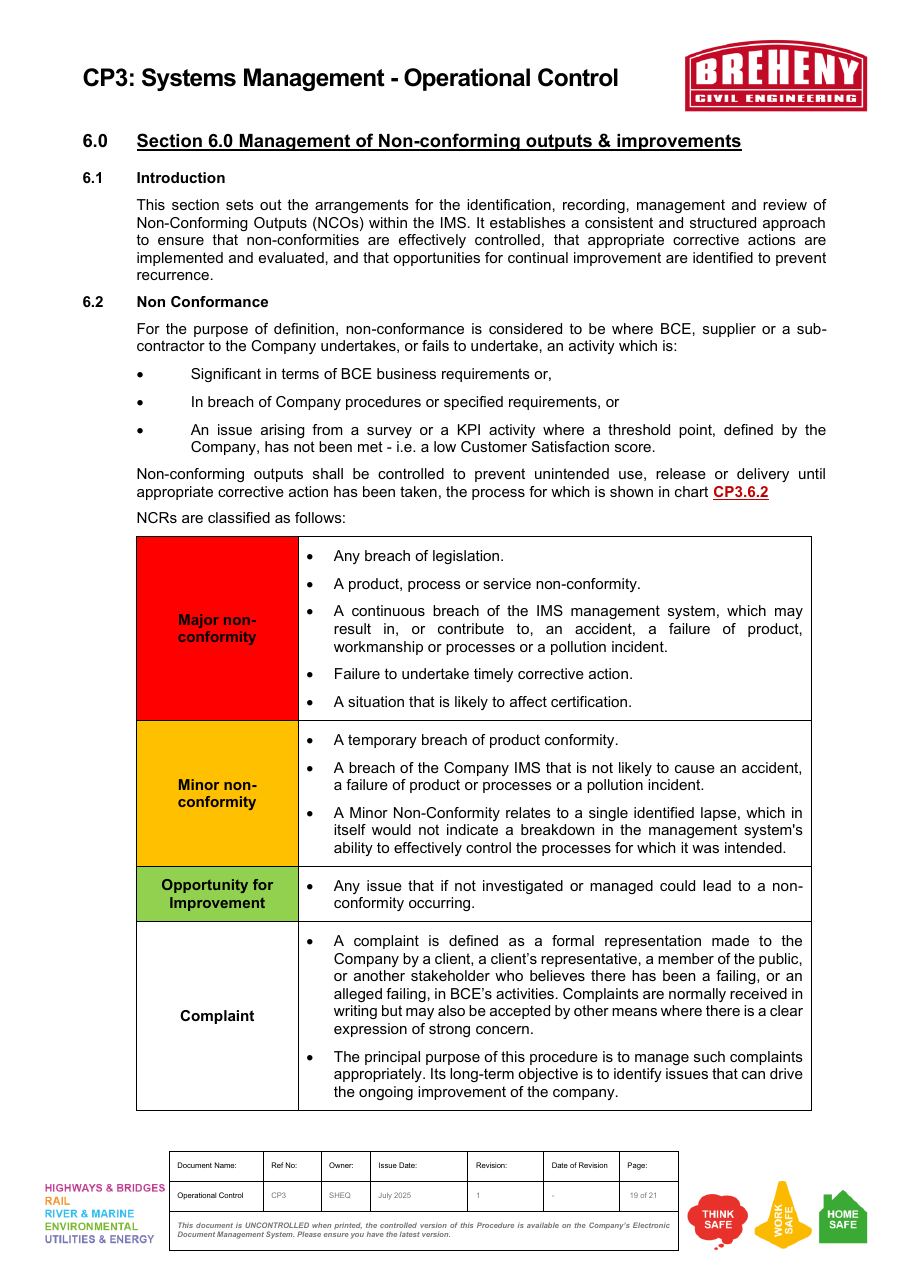
    NCRs are classified as follows:

    (see table below)

    6.3Non-conformance Reports (NCR)

    An NCR (Form CP3-F01) may be raised by any Employee who identifies an issue that could affect services to internal or external customers. The NCR should be sent to the Head of ESG who will add to the NCR register (Form CP3-F02). The Head of ESG will send the NCR to the appropriate Department Manager for action.

    NCR actions are to be completed promptly, closed out by the responsible person, and submitted to the Head of ESG to enable to register to be updated.

    NCR’s are to be regularly reviewed to identify trends and key issues, ensuring that actions are effective and verified through appropriate evidence (e.g., audits, data, or observed outcomes).

    If a second or third party has raised an NCR and is dissatisfied with the outcome this must be escalated to a Director or Senior Manager for review and action.

    Where NCRs highlight failures or weaknesses, improvements must be made to the IMS and a report highlighting significant issues and trends presented to the Directors. NCR date is to be used to drive continuous improvement through:

    • Management system reviews
    • Directors Meetings
    • Managers Briefing Days

    6.4Improvement

    In order to determine and select opportunities for improvement or to implement any necessary actions to meet the requirements of customers and relevant interested parties, or to enhance customer satisfaction, BCE drives improvement via the analysis of relevant data. The data inputs for the improvement process include:

    • Risk and opportunity evaluations;
    • Assessment of the changing needs and expectations of interested parties;
    • The conformity of existing products and services;
    • The effectiveness of our IMS;
    • Supplier performance;
    • Levels of customer satisfaction, including complaints and feedback;
    • Internal and external audit results;
    • Corrective action and non-conformance rates.

    BCE also ensures that opportunities for improvement from daily feedback on operational performance are evaluated by the SHEQ Manager which are typically implemented through the corrective action system. Opportunities for improvement from analysis of longer-term data and trends are evaluated and implemented through the management review process and are prioritised with respect to their relevance for achieving our quality objectives.

    The overall effectiveness of continual improvement program (including corrective actions taken as well as the overall progress towards achieving corporate level improvement objectives) is assessed through our management review process.

    Trends, significant nonconformities and improvement actions arising from this process shall form defined inputs to the IMS management review process.

    Documents you'll need

    6.5 Customer Feedback

    Customer feedback is captured to measure satisfaction and drive improvement. Methods include client satisfaction surveys, post-project reviews, KPI returns, day-to-day correspondence and complaints. Feedback (positive and negative) is logged centrally, reviewed by the Head of ESG and fed into Management Review. Complaints are treated as Non-Conforming Outputs and managed via Form , with root-cause analysis and corrective actions tracked through to close-out. Trends are used to update training, procedures and KPIs.

    Related form: (Non-Conformance / Complaint Record).

    Key points

    • Capture feedback via surveys, reviews, KPIs and complaints
    • Log all feedback centrally and review at Management Review
    • Treat complaints as NCOs and raise via Form
    • Track root cause and corrective actions to close-out
    • Use trends to improve training, procedures and KPIs
    From the source document(4 clauses)

    6.5Customer Feedback

    No text in source for this clause.

    6.5.1Methods for Capturing Feedback

    BCE captures meaningful feedback from clients, subcontractors, and other relevant stakeholders (e.g., project teams, suppliers) on areas of performance, both positive and negative. The feedback can be gathered through various methods, including but not limited to:

    • Monthly Progress Meetings & Site Visits: Key interested parties (clients, subcontractors, etc.) are encouraged to provide feedback during these meetings. The feedback is documented in the meeting minutes for future reference.
    • Site Visits: Regular visits are conducted to engage in informal conversations with clients and subcontractors. The focus of these discussions is on key performance areas (KPIs), such as quality, timeliness, and communication.
    • Direct Communication (Emails/Calls): Feedback is actively sought through direct communications such as emails or phone calls.
    • Face-to-Face Verbal Comments: Informal, direct feedback is captured during face-to-face interactions with clients or subcontractors.
    • Non-Conformance Reports (NCRs): Any issues identified during projects are captured in NCRs, which provide a formal mechanism for documenting concerns and feedback.
    • Post-contract lessons learnt provide real project insights that can be used as a source of customer feedback, enabling evaluation of customer satisfaction and drive continual improvement

    6.5.2Customer Satisfaction Monitoring

    Customer satisfaction shall be monitored using appropriate methods, which may include client feedback, progress meetings, project reviews, complaints, and postproject evaluations.

    Results shall be analysed to identify trends, improvement opportunities, and potential nonconformities. Outputs from customer satisfaction monitoring shall be recorded and form defined inputs to the IMS management review process.

    6.5.3Feedback Tracking and Continuous Improvement

    Feedback shall be captured by the responsible Delivery/Project Manager and submitted to the Admin Team and recorded. This includes any corrective or preventive actions taken in response to the feedback. The following processes will be followed to ensure that feedback is effectively used for continuous improvement:

    • Tracking Feedback: All feedback must be logged in a centralised system, including corrective actions, to ensure it is easily accessible for future reference.
    • Trend Analysis: Feedback will be analysed for patterns and trends, helping to identify systemic issues or areas of improvement across projects.
    • Management Review: Feedback and its associated actions, including any trends identified, will be presented at Management Review Meetings. Senior management is involved in this process to ensure that necessary decisions are made to address feedback and implement improvements.
    • Continuous Improvement: The data collected from feedback and the subsequent actions taken will be used to drive continuous improvement in processes, services, and customer satisfaction.

    Documents you'll need

Tables & figures

All tables, charts and diagrams extracted from the source PDF.