1 Purpose and Scope
Defines what the Integrated Management System (IMS) is, what it covers and where it applies. The IMS gives Breheny Civil Engineering Ltd a single framework for managing Safety, Health, Environment, Energy and Quality (SHEEQ) risks and opportunities, meeting legal and client requirements, and driving continual improvement. It applies to all construction, transportation and premises activities, with proportionate application allowed for short or lower-risk works. ISO 9001 Clause 8.3 (Design and Development) is formally excluded because Breheny builds to client designs.
Key points
- •IMS covers SHEEQ (Safety, Health, Environment, Energy, Quality); legacy 'SHEQ' references still apply
- •Energy scope includes all energy uses, plant, transport and premises — Significant Energy Uses (SEUs) identified via energy review
- •Carbon managed separately under PAS 2080:2023 verified system; interfaces handled via policies and risk-based planning
- •Aligned to ISO 9001:2015+A1:2024, ISO 14001:2015+A1:2024, ISO 45001:2023+A1:2024, ISO 50001:2018+A1:2024
- •ISO 9001 Clause 8.3 Design & Development is NOT APPLICABLE — Breheny builds to client-provided designs
- •Proportionate application of procedures permitted by Contracts Manager, agreed with Head of ESG; justification recorded in project workspace
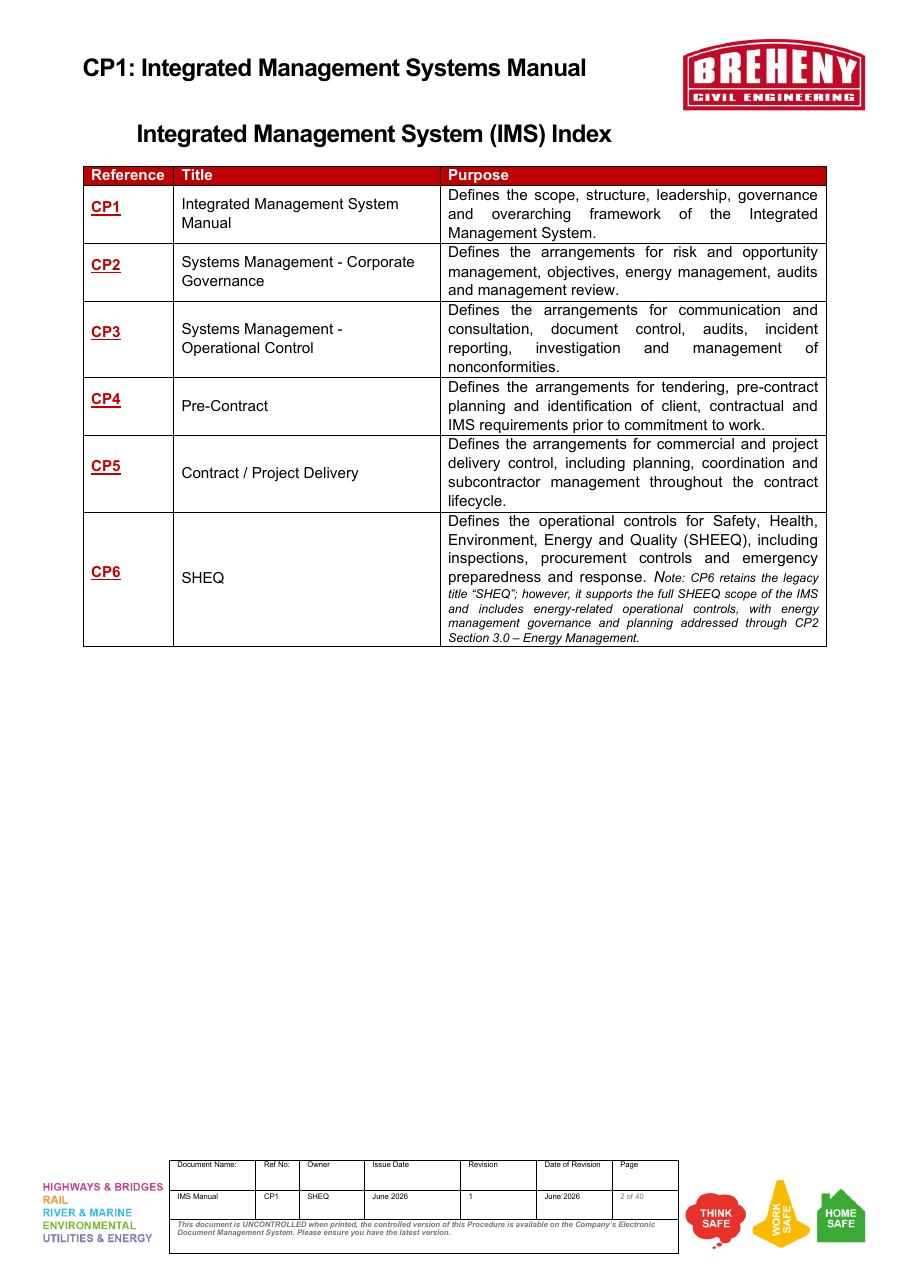
- •IMS Index lists CP1: IMSM–CP6: SHEQ and their purposes (front matter, p.2)
From the source document(6 clauses)
IMS IndexIntegrated Management System (IMS) Index
CP1 – Integrated Management System Manual: Defines the scope, structure, leadership, governance and overarching framework of the Integrated Management System.
CP2 – Systems Management - Corporate Governance: Defines the arrangements for risk and opportunity management, objectives, energy management, audits and management review.
CP3 – Systems Management - Operational Control: Defines the arrangements for communication and consultation, document control, audits, incident reporting, investigation and management of nonconformities.
CP4 – Pre-Contract: Defines the arrangements for tendering, pre-contract planning and identification of client, contractual and IMS requirements prior to commitment to work.
CP5 – Contract / Project Delivery: Defines the arrangements for commercial and project delivery control, including planning, coordination and subcontractor management throughout the contract lifecycle.
CP6 – SHEQ: Defines the operational controls for Safety, Health, Environment, Energy and Quality (SHEEQ), including inspections, procurement controls and emergency preparedness and response. Note: CP6 retains the legacy title “SHEQ”; however, it supports the full SHEEQ scope of the IMS and includes energy-related operational controls, with energy management governance and planning addressed through CP2 Section 3.0 – Energy Management.
1.1Purpose of the Integrated Management System
This document defines the scope, structure and key elements of Breheny Civil Engineering Ltd.’s Integrated Management System (IMS). Breheny’s IMS provides a consistent framework for managing Safety, Health, Environment, Energy, and Quality (SHEEQ) risks and opportunities, ensuring compliance with applicable legal and other requirements and supporting continual improvement in organisational performance (note: some legacy procedure titles may use “SHEQ”, however the IMS scope includes Energy and references to SHEEQ apply). The IMS also supports the consideration of wider sustainability, climate change and decarbonisation factors within business and project decision making, where relevant, through organisational policies, procedures, objectives and risk-based planning arrangements.
1.2Scope of the Integrated Management System
The scope of the IMS covers: Civil Engineering Construction activities, including associated project delivery, operational support functions, transportation activities and the occupied premises of the business. The scope of the energy management element of the IMS includes: Energy use associated with civil engineering and construction activities, transportation, plant and equipment, and the occupied premises of the business. The energy scope includes all energy uses, consumption and energy-related activities that can influence energy performance, including those identified through the energy review process and assessment of Significant Energy Uses (SEUs). The IMS applies to all projects, activities and operations undertaken by Breheny Civil Engineering Ltd., except where formally agreed otherwise in accordance with Company procedures and client requirements. While carbon, climate change and decarbonisation considerations are recognised as relevant external and strategic issues, carbon is managed through a PAS 2080 verified carbon management system that operates independently of the IMS. Interfaces between the IMS and the carbon management system are addressed through organisational policies, procedures, objectives and risk based planning arrangements, where relevant.
1.3Applicability and Boundaries
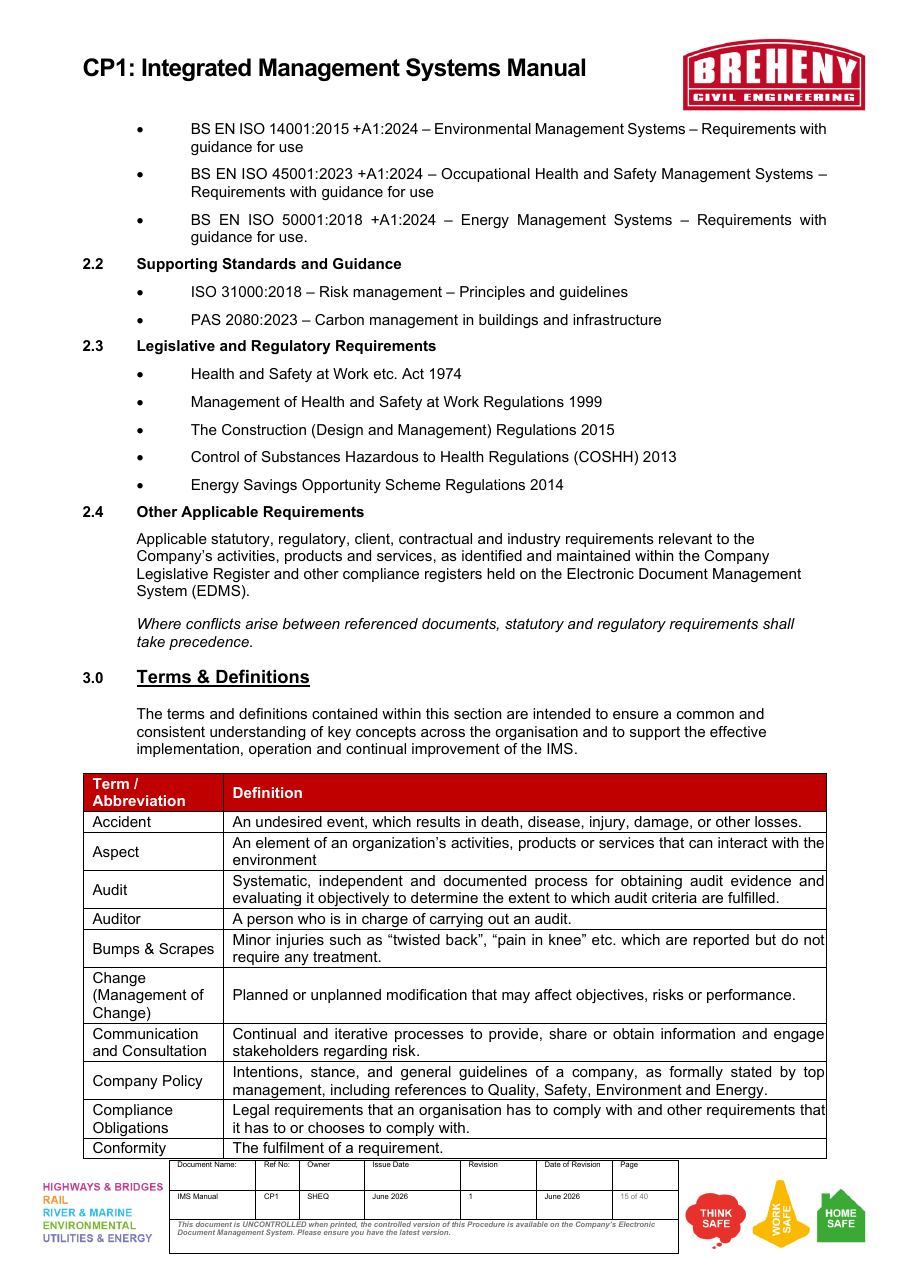
The IMS has been established and is maintained in accordance with the requirements of the following management system standards: • BS EN ISO 9001:2015 +A1:2024 – Quality Management Systems • BS EN ISO 14001:2015 +A1:2024 – Environmental Management Systems • BS EN ISO 45001:2023 +A1:2024 – Occupational Health and Safety Management Systems • BS EN ISO 50001:2018 +A1:2024 – Energy Management Systems • The boundaries and applicability of the IMS have been determined taking into account: • The nature of the Company’s activities and services; • Internal and external issues; • The needs and expectations of interested parties; • Applicable statutory, regulatory, contractual and industry requirements.
1.4Non-Applicability of ISO 9001:2015 Clause 8.3 – Design and Development
Breheny Civil Engineering Ltd. does not undertake the design or development of products or services within the scope of its Quality Management System. All construction works are delivered in accordance with client-provided designs, specifications and requirements, or designs produced by third-party designers appointed by the client. The Company’s activities relate to the planning, management and construction of works to those defined requirements. As such, the requirements of ISO 9001:2015 Clause 8.3 – Design and Development of Products and Services are determined to be not applicable to the scope of the IMS. This determination does not affect the Company’s responsibility to: • Review client requirements; • Verify design information for constructability; • Carry out inspections, measurements and checks to confirm that constructed works conform to approved drawings, specifications and quality plans; • Meet all applicable statutory, regulatory and contractual requirements. The non-applicability of Clause 8.3 has been considered in accordance with ISO9001 Clause 4.3 and does not compromise the Company’s ability to provide conforming products and services or to enhance customer satisfaction.
1.5Applicability of Company Procedures
The applicability and extent of relevant IMS requirements, Company Procedures and associated controls shall be determined on a risk and opportunity basis, taking account of the nature, scope, duration, complexity and location of the works, applicable legal and other requirements, client requirements, interfaces with other activities, and the potential SHEEQ, operational and commercial consequences of failure.
Where works are of short duration or lower risk, the application of IMS requirements, procedures and controls may be implemented on a proportionate basis, provided this does not affect the organisation’s ability to achieve intended outcomes, fulfil compliance obligations, meet client and contractual requirements, ensure conformity of products and services, prevent injury and ill health, protect the environment, and support improvement in energy performance. The level of procedural and operational control shall be determined by the Contracts Manager based on assessed risks and opportunities and agreed with the Head of Environment, Social and Governance (ESG).
For maintenance, framework or multiple-project arrangements, the Contracts Manager or Framework Manager shall determine the applicability and extent of relevant IMS requirements, procedures and controls, taking account of aggregated and project-specific risks and opportunities, with guidance sought from the Head of ESG where proportionate application, exceptions or uncertainty arise.
Any proposed exemption or proportionate application of IMS requirements, procedures or controls shall be justified by the Contracts Manager or Framework Manager, and the justification shall be recorded and retained as documented information within the relevant project workspace.